
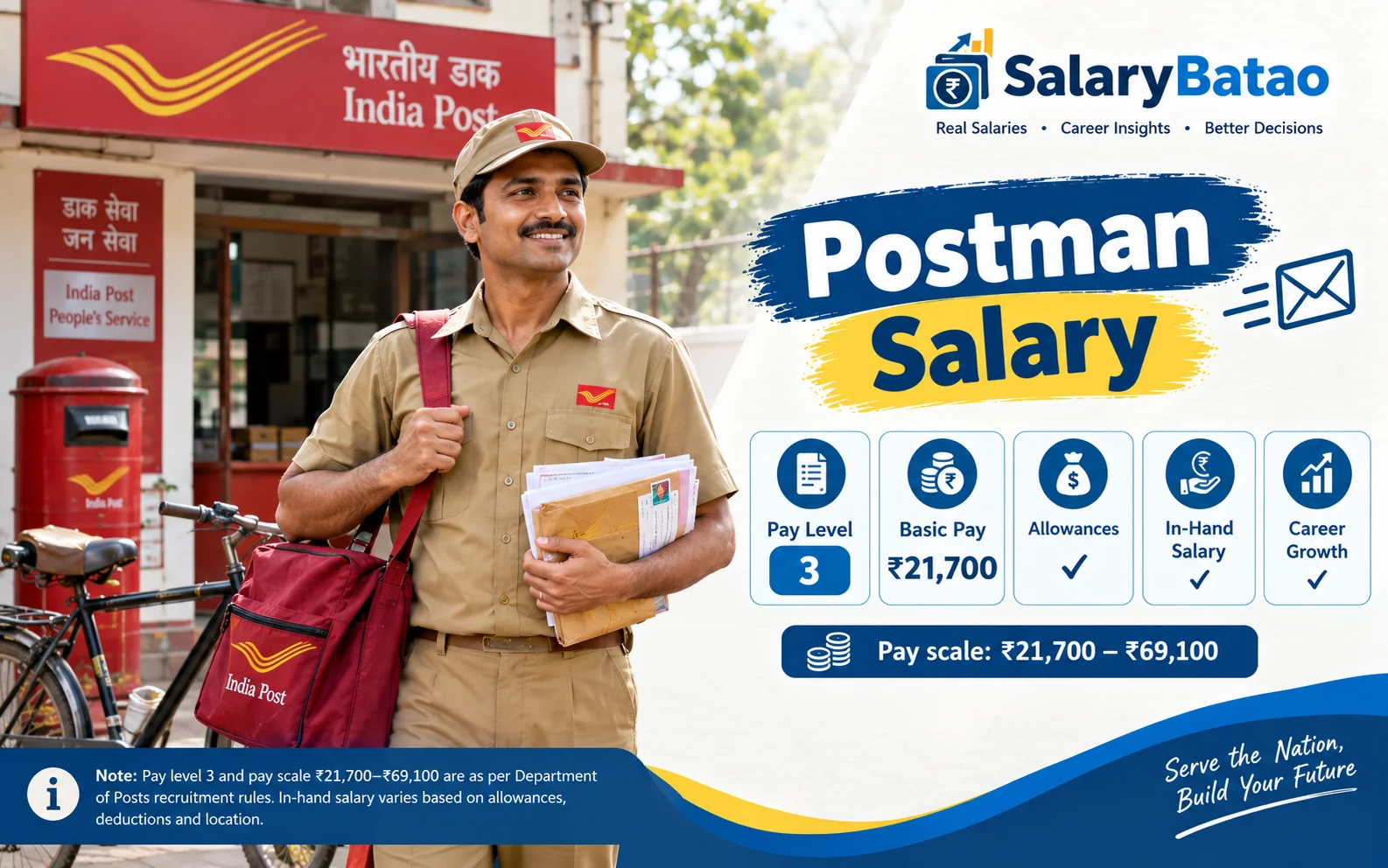
A Postman Salary in 2026 starts at ₹21,700 basic pay (Pay Level 3), which grows to roughly ₹36,000–₹43,000 in hand per month once DA, HRA and transport allowance land in your account.
Let’s be honest: nobody Googles “Postman Salary” because they love spreadsheets. You’re deciding whether the khaki uniform, the bicycle bell and the government job tag are worth it. Or you’ve just joined and your first pay slip doesn’t match the number your cousin quoted.
This guide fixes both problems. You’ll get the real 2026 numbers, the maths behind them, a city-wise breakdown, and a copy-paste method to check your own slip.
Prefer Hinglish? There’s a dedicated section for “Postman Ki Salary Kitni Hoti Hai” below.
Postman Salary at a Glance (2026)
| Item | 2026 figure |
|---|---|
| Pay Level | Level 3 (7th CPC pay matrix) |
| Entry basic pay | ₹21,700 per month |
| Maximum basic pay | ₹69,100 per month |
| Dearness Allowance (DA) | 60% of basic (since 1 Jan 2026) |
| Gross (metro, entry) | ≈ ₹46,990 per month |
| In-hand (metro, entry) | ≈ ₹43,200 per month |
| In-hand (small town, entry) | ≈ ₹36,000 per month |
| Next DA hike | 3% (to 63%) expected, not yet notified as of 3 Oct 2026 |
Author’s take: The biggest mistake I see is people treating “₹21,700” as the salary. It’s the starting block. DA alone adds ₹13,020 on top, which is why a Postman’s real pay is nearly double the basic.
Also Read: Hamraaz Login
What Is the Salary of a Postman in India? (Short Answer)
A regular Department of Posts Postman is a Group C employee at Pay Level 3. Basic pay starts at ₹21,700 and can reach ₹69,100 across a full career, according to the 7th Central Pay Commission pay matrix.
Gramin Dak Sevaks (GDS) are different. They’re paid a TRCA, not a pay-matrix salary. More on that shortly.
Postman Salary per Month in 2026: The Full Breakdown
Here’s a Level 3 entry-stage slip for an X-class metro, using DA at 60%.
| Component | Amount (₹/month) | How it’s calculated |
|---|---|---|
| Basic pay | 21,700 | Level 3, first cell |
| Dearness Allowance (DA) | 13,020 | 60% × 21,700 |
| House Rent Allowance (HRA) | 6,510 | 30% × 21,700 (X-class) |
| Transport Allowance (TA) | 3,600 | Level 3–8, higher-TA cities |
| DA on TA | 2,160 | 60% × 3,600 |
| Gross salary | 46,990 | Sum of the above |
| NPS (employee, 10%) | 3,472 | 10% × (basic + DA) |
| CGHS, CGEGIS and other deductions | ≈ 290 | Varies by slip |
| Net / in-hand | ≈ 43,228 | Gross − deductions |
Postal Study’s April 2026 pay structure for a Postman uses the same components and arrives at the same ₹46,990 gross and about ₹43,228 take-home.
Key terms, defined
- Pay Level / Pay Matrix: The grid that fixes basic pay for every central government post. Postman sits at Level 3.
- Dearness Allowance (DA): A cost-of-living top-up, paid as a percentage of basic and revised twice a year.
- HRA: Rent allowance set by city class: 30% (X), 20% (Y), 10% (Z) when DA is above 50%.
- TA: Transport allowance, higher in big cities.
- NPS: National Pension System. A 10% employee contribution is deducted from basic + DA.
Why this matters: DA and HRA are percentages of basic. So every increment in basic pay quietly lifts three other lines on your slip. That’s the compounding effect most people miss.
Reading your Postman Salary Slip line by line
Your Postman Salary Slip has three zones:
- Earnings: Basic, DA, HRA, TA, DA on TA, plus any postal-specific allowances.
- Deductions: NPS, CGHS, CGEGIS, and sometimes licence fee or recoveries.
- Net pay: The number that hits your bank.
If any earnings line looks off, check DA first. It changes twice a year, and a stale rate is the most common slip error.
Post Office Postman Salary per Month by City Tier
Same job, same basic, different pay. The swing comes from HRA and TA.
| City class | HRA | TA + DA on TA | Gross | In-hand (approx.) |
|---|---|---|---|---|
| X (e.g. Mumbai, Delhi, Bengaluru) | 6,510 | 5,760 | 46,990 | ₹43,200 |
| Y (e.g. Lucknow, Patna, Kochi) | 4,340 | 5,760 | 44,820 | ₹41,060 |
| Z (smaller towns) | 2,170 | 2,880 | 39,770 | ₹36,010 |
All figures at entry basic ₹21,700, DA 60%, deductions ≈ ₹3,762. These are estimates; your posting decides the exact slip.
That’s a ₹7,000+ monthly gap between a metro and a small town, for identical work.
The in-hand formula (copy it)
In-hand ≈ Basic + DA + HRA + TA + DA on TA − (10% × (Basic + DA)) − ₹290
Plug in your own basic and city class. It takes 60 seconds.
Also Read: STI Salary in Maharashtra
Postman Salary in India: State-Wise View
There is no separate “state salary” for a central government Postman. The pay matrix is national. What changes is your posting city’s class.
| State | Typical tier of main postings | What to expect (entry, in-hand) |
|---|---|---|
| Postman Salary in UP | Lucknow, Kanpur (Y); most towns (Z) | ₹36,000–₹41,000 |
| Postman Salary in Bihar | Patna (Y); most towns (Z) | ₹36,000–₹41,000 |
| Postman Salary in Maharashtra | Mumbai, Pune (X); Nagpur (Y); others (Z) | ₹36,000–₹43,000 |
| Postman Salary in Odisha | Bhubaneswar (Y); most towns (Z) | ₹36,000–₹41,000 |
| Postman Salary in Kerala | Kochi, Thiruvananthapuram (Y); others (Z) | ₹36,000–₹41,000 |
| Postman Salary in Karnataka | Bengaluru (X); Mysuru, Hubballi (Y/Z) | ₹36,000–₹43,000 |
| Postman Salary in Punjab | Chandigarh, Ludhiana (Y); others (Z) | ₹36,000–₹41,000 |
Author’s take: If a website shows a wildly different “Indian Postman Salary” for each state, it’s usually mixing allowances, not changing basic pay. Always ask: what tier is the posting?
Postman Salary After 5 Years
Basic pay rises by roughly 3% each year, moving you one cell along the Level 3 row of the pay matrix. After five increments, basic lands near ₹25,300 (confirm against the official matrix for your joining date).
Here’s the metro projection at DA 60%:
| Component | Entry (year 0) | After 5 years |
|---|---|---|
| Basic | 21,700 | ≈ 25,300 |
| DA (60%) | 13,020 | 15,180 |
| HRA (30%) | 6,510 | 7,590 |
| TA + DA on TA | 5,760 | 5,760 |
| Gross | 46,990 | ≈ 53,830 |
| In-hand | ≈ 43,200 | ≈ 49,500 |
That’s about ₹6,300 more every month, without a promotion. It happens because three allowances ride on basic.
Beyond increments, two routes push pay higher:
- MACP (Modified Assured Career Progression): A financial upgrade after 10, 20 and 30 years if you haven’t been promoted.
- Departmental promotion: Postal Assistant and Sorting Assistant sit at Level 4, starting at ₹25,500 basic.
GDS Postman Salary: TRCA vs Pay Matrix
People search “GDS Postman Salary” all the time, so let’s clear the confusion.
A Gramin Dak Sevak (GDS) works in a rural branch post office. They are not on the 7th CPC pay matrix. They receive TRCA (Time Related Continuity Allowance), which is tied to working hours.
| GDS post | TRCA slab (monthly) |
|---|---|
| Branch Postmaster (BPM) | ₹12,000 – ₹29,380 |
| Assistant BPM (ABPM) | ₹10,000 – ₹24,470 |
| Dak Sevak | ₹10,000 – ₹24,470 |
Source: Department of Posts GDS engagement notification, July 2026. TRCA grows about 3% a year, with DA paid on top.
Before and after: GDS to Postman
| GDS (ABPM, entry) | Postman (Level 3, entry) | |
|---|---|---|
| Pay system | TRCA | 7th CPC pay matrix |
| Base figure | ₹10,000 | ₹21,700 basic |
| Approx. monthly in-hand | ≈ ₹16,000 (TRCA + 60% DA, estimate) | ₹36,000 (small town) to ₹43,000 (metro) |
| Multiple | 1× | roughly 2.2× to 2.7× |
| Pension | GDS-specific benefits | NPS with CGHS cover |
The jump is huge. It’s why many GDS staff prepare for departmental exams. Eligibility and quotas follow Department of Posts rules, so check the current recruitment notice.
Also Read: Cobra Commando Salary
Postman Salary After 8th Pay Commission
This is the question everyone’s asking, so here is what’s confirmed and what’s guesswork.
Confirmed:
- The government formally constituted the 8th Pay Commission on 3 November 2025 (ClearTax).
- It must submit recommendations within 18 months, which points to roughly mid-2027.
- The expected effective date is 1 January 2026, with arrears payable once the new pay structure is approved (Union Cabinet statements and Tax2win).
- The NC-JCM staff side submitted a memorandum on 14 April 2026 seeking a fitment factor of 3.833 and ₹69,000 minimum pay (Toolisky).
Not decided yet: the fitment factor, the pay matrix, HRA structure and pension formula.
What different fitment factors could mean
Today a Level 3 Postman’s basic plus DA is ₹34,720. Fitment is applied to basic, and DA typically restarts from zero.
| Scenario | Fitment factor | New entry basic | vs today’s basic + DA |
|---|---|---|---|
| Conservative | 1.92 | ₹41,664 | +20% |
| Mid-range | 2.28 | ₹49,476 | +43% |
| High-end | 2.86 | ₹62,062 | +79% |
| Union demand | 3.833 | ₹83,176 | +140% |
Illustrative maths only. Fresh DA, HRA and TA will sit on top of the new basic.
Author’s take: Treat the 3.833 figure as an opening bid, not a forecast. Unions ask high; commissions settle lower. Plan your finances around the conservative and mid-range rows.
The DA hike to watch this month
DA moved from 58% to 60% effective 1 January 2026. The July 2026 instalment is widely expected to add 3%, taking DA to 63%, and unions expect the announcement before Dussehra on 20 October 2026. As of 3 October, it hasn’t been formally notified.
If it lands at 63%, a metro entry-level Postman’s gross rises by about ₹759 per month (₹651 extra DA plus ₹108 extra DA on TA), with arrears from July.
Postman Ki Salary Kitni Hoti Hai? (Hinglish Quick Answer)
Agar aap puch rahe ho “Postman Ki Salary Kitni Hoti Hai”, toh seedha jawab: starting basic ₹21,700 hai, aur DA, HRA, TA jodke government Postman ki salary lagbhag ₹36,000 se ₹43,000 per month in-hand ho jaati hai.
Postman ka salary kitna hota hai yeh poori tarah aapki posting par depend karta hai. Metro mein HRA zyada milta hai, chhote town mein kam.
Sarkari Postman ki salary kitni hoti hai is sawal ka ek aur pehlu hai: GDS aur regular Postman alag hote hain. GDS ko TRCA milta hai (₹10,000 se shuru), jabki regular Indian Postman ki salary Level 3 pay matrix se tay hoti hai.
Post office mein Postman ki salary kitni hoti hai, aur 8th Pay Commission ke baad kitni badhegi? Report aane tak fitment factor tay nahi hai, isliye abhi sirf andaaza lagaya ja sakta hai.
How Postman Pay Compares With Other India Post Posts
| Post | Pay system | Entry basic / TRCA |
|---|---|---|
| Gramin Dak Sevak (ABPM / Dak Sevak) | TRCA | ₹10,000 |
| Gramin Dak Sevak (BPM) | TRCA | ₹12,000 |
| Multi Tasking Staff (MTS) | Level 1 | ₹18,000 |
| Postman / Mail Guard | Level 3 | ₹21,700 |
| Postal Assistant / Sorting Assistant | Level 4 | ₹25,500 |
Source: Department of Posts pay structure under the 7th CPC.
A Postman starts about 20% above MTS and about 15% below a Postal Assistant. That’s why Postman is a popular stepping stone.
Also Read: Havaldar Salary
Mini Case Study: The ₹5,000 Slip Surprise
(An illustrative example, with numbers computed from the 2026 matrix.)
Sanjay is a newly appointed Postman posted in Lucknow. A video told him to expect about ₹36,000 in hand. His first slip shows roughly ₹41,060.
What happened? The video assumed Z-class HRA and TA. Lucknow is a Y-class city, so HRA is ₹4,340 instead of ₹2,170 and TA with DA is ₹5,760 instead of ₹2,880. That’s a ₹5,050 gap.
The lesson: Don’t trust any Postman Salary number until you know the posting tier and the DA rate it used.
The Postman Salary Audit: A 5-Step Workflow You Can Copy
Use this every January and July, when DA changes.
- Note your basic. Find it on your slip and confirm it matches your pay matrix cell.
- Check DA. Multiply basic by the current DA rate (60% now) and compare.
- Check your city class. Match HRA (30/20/10%) and TA to your posting.
- Recompute NPS. It should equal 10% of (basic + DA).
- Compare net pay to the formula above. A gap over ₹300 deserves a question to your accounts office.
Simple template
| Line | Your figure |
|---|---|
| Basic | ₹____ |
| DA (___%) | ₹____ |
| HRA (___%) | ₹____ |
| TA + DA on TA | ₹____ |
| Gross | ₹____ |
| NPS (10% of basic + DA) | ₹____ |
| Other deductions | ₹____ |
| Net | ₹____ |
Common Mistakes When Reading Postman Salary Figures
- Quoting basic as the salary. Basic is roughly 45–60% of gross.
- Using an old DA rate. Some sites still show 55%. The current rate is 60%.
- Ignoring city class. It can swing take-home by over ₹7,000.
- Mixing GDS and regular pay. TRCA and the pay matrix are separate systems.
- Trusting self-reported averages. A Glassdoor India listing, built on just 23 submissions, showed an average of about ₹22,850 a year. That’s clearly not a real salary picture.
- Treating 8th CPC projections as promises. No fitment factor has been notified.
Is the Postman Salary Worth It? My Verdict
Author’s take: For a 12th-pass candidate, a Postman Salary of ₹36,000–₹43,000 in hand, with job security, pension coverage and annual increments, is hard to beat in the non-gazetted central pool. The catch is the work itself: long outdoor rounds in every weather.
If you’re a GDS today, Postman is the single biggest pay jump you can realistically target. If you’re a graduate, compare it with Postal Assistant at Level 4.
Conclusion
The Postman Salary in 2026 is more than the ₹21,700 headline. With DA at 60%, HRA and TA, a regular India Post Postman takes home roughly ₹36,000 to ₹43,000 a month at entry level, rising to about ₹49,500 in a metro after five years.
The next two events to watch are the 63% DA announcement and the 8th Pay Commission report, expected around mid-2027. Until then, run the five-step audit twice a year and your slip will never surprise you.
Data notes: pay-level and TRCA figures come from the Department of Posts and the 7th CPC pay matrix; DA and 8th CPC status from Union Cabinet announcements as reported by ClearTax, Tax2win, Toolisky and Whalesbook; the sample slip matches Postal Study’s April 2026 structure; the self-reported average is from Glassdoor India. In-hand figures are estimates and vary by posting and deductions.
Key Takeaways
- Entry basic pay is ₹21,700 at Pay Level 3, rising to ₹69,100.
- DA is 60% since January 2026, with a 3% rise to 63% expected but not yet notified.
- In-hand pay is about ₹36,000 (small town) to ₹43,200 (metro) at entry.
- After five years, a metro Postman takes home roughly ₹49,500.
- GDS staff get TRCA (₹10,000–₹29,380), not the pay matrix.
- The 8th Pay Commission has no fitment factor yet; the report is due around mid-2027.
- Audit your slip every January and July.
Summary
A Postman is a Level 3, Group C central government employee. Pay is basic plus DA, HRA, TA and DA on TA, minus NPS and small deductions. City class drives most of the variation across states. GDS pay works on a separate TRCA system. The 8th Pay Commission could lift pay substantially, but the numbers are not final.
FAQs
1. What is the Postman Salary in India in 2026?
A regular Postman earns a basic of ₹21,700 at Pay Level 3. With 60% DA, HRA and TA, gross is about ₹39,770 to ₹46,990 per month, and in-hand is roughly ₹36,000 to ₹43,200 depending on city class.
2. What is the Postman Salary per month in hand?
For a metro posting at entry level, the Postman Salary in hand is about ₹43,200 per month. In a Z-class town it is about ₹36,000. NPS and other deductions take roughly ₹3,760.
3. What will the Postman Salary be after the 8th Pay Commission?
It isn’t decided. If the fitment factor is 1.92 to 2.86, entry basic would be about ₹41,664 to ₹62,062. The Commission’s report is due around mid-2027, with an expected effective date of 1 January 2026.
4. What is the GDS Postman Salary?
GDS staff aren’t on the pay matrix. The Postman Salary equivalent for GDS is TRCA: ₹12,000 to ₹29,380 for BPM and ₹10,000 to ₹24,470 for ABPM and Dak Sevak, plus DA and a 3% annual increase.
5. What is the Postman Salary after 5 years?
After five annual increments, basic rises to about ₹25,300. At DA 60% in a metro, that gives a gross of about ₹53,830 and an in-hand Postman Salary near ₹49,500 per month.
