

Last Update: 29 July 2026
7.5 LPA in hand salary is typically around ₹52,000–₹57,000 per month, depending on your salary structure, employee PF contribution, professional tax, insurance, variable pay, and whether the quoted ₹7.5 lakh CTC includes employer-side benefits.
If you are searching for 7.5 LPA in hand salary, the first thing you need to understand is simple: ₹7.5 LPA is usually CTC, not your actual take-home salary.
A ₹7.5 lakh annual CTC can translate into a monthly bank credit somewhere around ₹52,000 to ₹57,000 in a common salary structure. But there is no universal answer. Two employees with the same 7.5 LPA CTC can receive different in-hand salaries because their employers structure basic salary, provident fund, gratuity, insurance, variable pay and other components differently.
The most important distinction is this:
CTC ≠ Gross Salary ≠ In-Hand Salary
That difference is where most salary calculations go wrong.
7.5 LPA In Hand Salary at a Glance
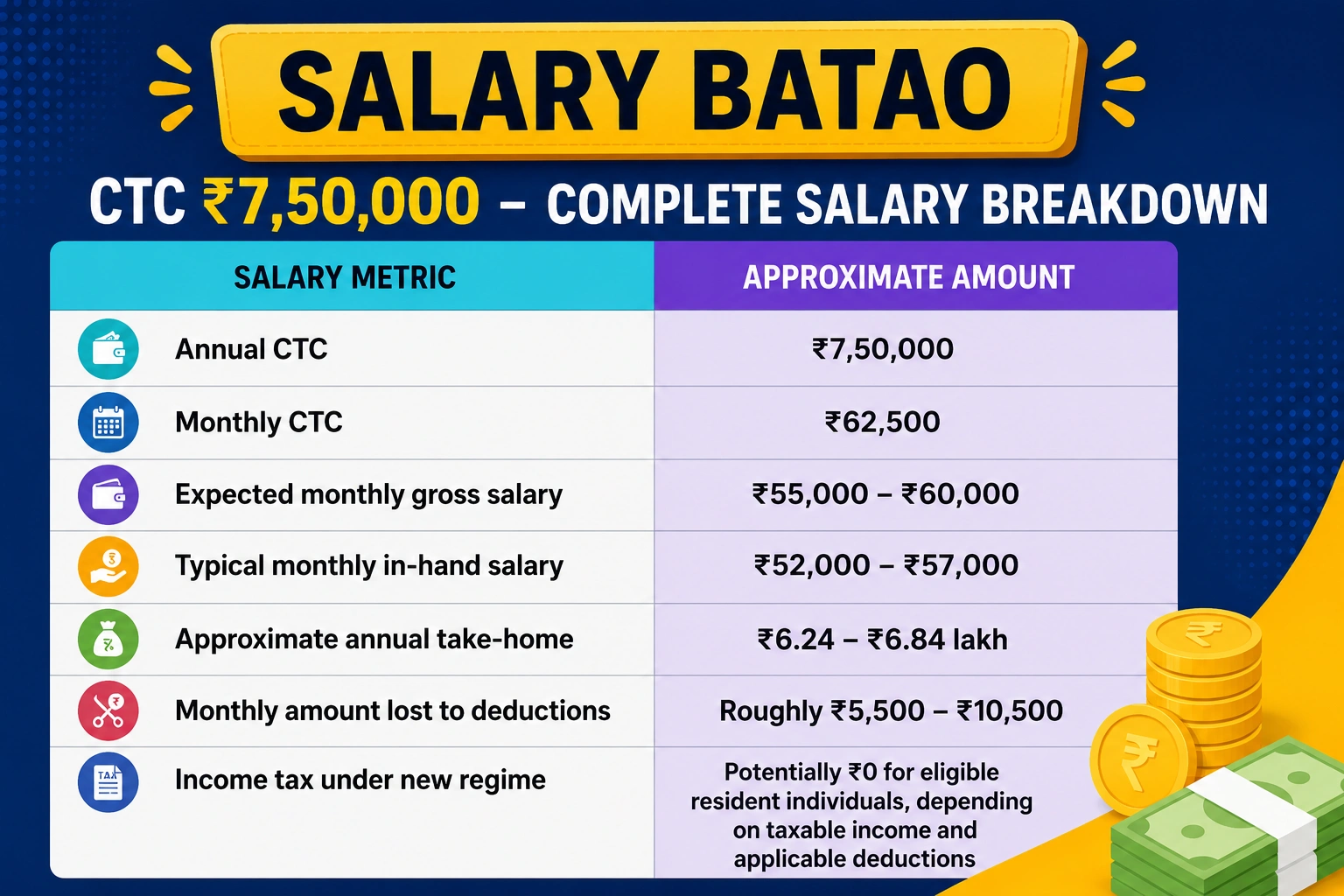
| Salary Metric | Approximate Amount |
|---|---|
| Annual CTC | ₹7,50,000 |
| Monthly CTC | ₹62,500 |
| Expected monthly gross salary | ₹55,000–₹60,000 |
| Typical monthly in-hand salary | ₹52,000–₹57,000 |
| Approximate annual take-home | ₹6.24–₹6.84 lakh |
| Monthly amount lost to deductions | Roughly ₹5,500–₹10,500 |
| Income tax under new regime | Potentially ₹0 for eligible resident individuals, depending on taxable income and applicable deductions |
Important: The ₹52,000–₹57,000 range is an estimate, not a guaranteed payroll figure. The exact 7.5 LPA CTC in hand salary depends heavily on your offer letter.
What Does 7.5 LPA Mean?
7.5 LPA means an annual compensation of ₹7,50,000, where LPA stands for Lakhs Per Annum.
So:
- 7.5 LPA = ₹7,50,000 per year
- 7.5 LPA monthly CTC = ₹62,500
- 7.5 LPA salary per month is not necessarily ₹62,500 in your bank account
- 7.5 LPA in hand is lower because of deductions and salary components
The basic formula
₹7,50,000 ÷ 12 = ₹62,500 per month
This gives you the monthly CTC equivalent, not your actual monthly take-home.
This distinction matters because CTC may include:
- Basic salary
- House Rent Allowance (HRA)
- Special allowance
- Employer EPF contribution
- Gratuity
- Medical insurance
- Variable pay
- Performance bonus
- Other benefits
Some of these components never reach your bank account as monthly cash.
7.5 LPA In Hand Salary Per Month: The Real Calculation
Let’s create a realistic example.
Assume a company offers:
Annual CTC: ₹7,50,000
A hypothetical breakup could look like this:
| Component | Annual | Monthly |
|---|---|---|
| Basic Salary | ₹3,00,000 | ₹25,000 |
| HRA | ₹1,50,000 | ₹12,500 |
| Special/Other Allowance | ₹1,70,000 | ₹14,167 |
| Employer PF | ₹36,000 | ₹3,000 |
| Gratuity | ₹14,400 | ₹1,200 |
| Insurance/Benefits | ₹9,600 | ₹800 |
| Variable Pay | ₹70,000 | ₹5,833 |
| Total CTC | ₹7,50,000 | ₹62,500 |
In this example, your actual monthly cash salary is not ₹62,500.
Your fixed monthly earnings before deductions are closer to:
₹25,000 + ₹12,500 + ₹14,167 = ₹51,667
The employer’s PF contribution, gratuity and insurance are part of CTC but are not monthly cash in your bank account.
If the ₹70,000 variable component is performance-linked, you may also not receive it every month.
This is why blindly dividing 7.5 LPA by 12 gives the wrong answer to the question: “What will be in hand salary for 7.5 LPA?”
7.5 LPA Salary Breakup: CTC vs Gross vs In-Hand
Understanding these three terms is the fastest way to stop getting confused by salary offers.
1. CTC
CTC means Cost to Company.
It represents the total annual cost the employer associates with employing you.
It may include benefits that are not paid directly to you each month.
2. Gross Salary
Gross salary generally represents your earnings before employee-side deductions such as:
- Employee PF
- Professional tax, where applicable
- Income tax/TDS
- Insurance deductions
- Other payroll deductions
The exact definition can vary according to the company’s payroll structure.
3. In-Hand Salary
In-hand salary, also called take-home salary, is the amount actually credited to your bank account after applicable deductions.
A simplified formula is:
In-Hand Salary = Gross Cash Salary − Employee Deductions − TDS − Other Payroll Deductions
That is the number you should care about when calculating your monthly budget.
Why ₹7.5 LPA CTC Does Not Mean ₹62,500 In Hand
This is the biggest misconception surrounding 7.5 LPA monthly salary.
Suppose your CTC is ₹7.5 lakh.
You calculate:
₹7,50,000 ÷ 12 = ₹62,500
Then you assume:
“My salary will be ₹62,500 per month.”
Not necessarily.
Imagine the employer includes:
- ₹36,000 employer PF
- ₹14,400 gratuity
- ₹9,600 insurance
- ₹70,000 annual variable pay
That already changes your actual monthly cash flow significantly.
The employer’s CTC calculation is designed to measure total employment cost. Your bank account reflects cash earnings after deductions.
These are two completely different perspectives.
7.5 LPA In Hand Salary After Tax in 2026
Tax is where many outdated salary articles become misleading.
For the 2026 tax year, the new tax regime has become particularly important for salaried employees. The Income Tax Department’s AY 2026–27 guidance lists the new-regime slabs beginning with nil tax up to ₹4 lakh, followed by 5%, 10%, 15%, 20%, 25% and 30% bands as income rises. It also states that the Section 87A rebate can be up to ₹60,000 where eligible taxable income does not exceed ₹12 lakh under the new regime. A 4% health and education cess applies to income tax where tax is payable.
Checkout “Income Tax India” official website for more info.
For a straightforward salaried employee whose taxable income remains within the relevant rebate threshold, income tax may therefore be zero under the new regime.
But don’t make the mistake of assuming:
“7.5 LPA CTC means zero tax in every case.”
Your tax calculation depends on taxable income, not simply the headline CTC.
Other income can matter, and the exact treatment of salary components and deductions must be considered.
2026 tax takeaway
For many employees earning around ₹7.5 lakh CTC, PF and other payroll deductions may have a bigger immediate impact on monthly take-home pay than income tax under the new regime.
The Income Tax Department also confirms that the new regime remains the default regime, while eligible taxpayers can opt out and choose the old regime.
Which Tax Regime Is Better for 7.5 LPA?
For 7.5 LPA, the new tax regime is often the more practical starting point in 2026, especially if you do not have substantial deductions and exemptions available under the old regime.
However, “better” depends on your personal financial situation.
New regime may suit you if:
- You do not claim significant deductions
- You have limited eligible investments
- You do not have a large eligible home-loan interest deduction
- You prefer simpler tax calculations
- Your taxable income falls within the applicable rebate threshold
Old regime may be worth comparing if:
- You have substantial eligible deductions
- You pay eligible home-loan interest
- You have significant qualifying investments
- You claim eligible HRA-related exemptions
- Your personal tax profile makes deductions valuable
My practical advice
Don’t choose your tax regime based on internet comments saying “new regime is always better.”
Calculate both.
The correct question is:
Which regime produces the lowest total annual tax for my actual taxable income and eligible deductions?
For a typical ₹7.5 LPA salaried employee with limited deductions, the new regime is likely to be attractive in 2026. But your payroll department’s TDS calculation and your final ITR position should be checked against your specific circumstances.
EPF and Other Deductions at 7.5 LPA
Employee Provident Fund can significantly affect your 7.5 LPA in hand salary.
According to EPFO, the employee contribution is generally 12% of basic wages plus applicable dearness and retaining allowance, while the employer also contributes 12%, with the employer’s contribution divided between EPF and the pension component according to the applicable rules.
This means your PF deduction depends on your basic salary, not simply on your total CTC.
For example:
If Basic = ₹25,000/month
12% employee PF:
₹25,000 × 12% = ₹3,000/month
Annual employee PF:
₹3,000 × 12 = ₹36,000
That ₹3,000 monthly contribution reduces your bank credit but simultaneously builds your retirement savings.
This is an important distinction:
Not every deduction is “lost money.”
PF is a deduction from your cash salary, but it is also money accumulating for your future financial security.
A More Realistic 7.5 LPA In-Hand Salary Example
Consider an employee with:
- CTC: ₹7,50,000
- Monthly CTC equivalent: ₹62,500
- Basic salary: ₹25,000/month
- Employer PF: ₹3,000/month
- Gratuity: ₹1,200/month
- Insurance: ₹800/month
- Variable pay: ₹70,000/year
- Employee PF: ₹3,000/month
A simplified calculation might look like:
Annual CTC: ₹7,50,000
Less components not paid as regular monthly cash:
- Employer PF: ₹36,000
- Gratuity: ₹14,400
- Insurance: ₹9,600
- Variable pay: ₹70,000
Approximate fixed monthly cash components:
₹7,50,000 − ₹36,000 − ₹14,400 − ₹9,600 − ₹70,000 = ₹6,20,000
₹6,20,000 ÷ 12 ≈ ₹51,667
Then subtract employee PF:
₹51,667 − ₹3,000 ≈ ₹48,667
This example could therefore produce a take-home salary around ₹48,000–₹50,000 per month, before considering other payroll details.
Another employer might structure the same ₹7.5 LPA with a higher fixed component and lower variable pay, producing a take-home salary closer to ₹52,000–₹57,000.
The lesson
There is no single “correct” in hand salary for 7.5 LPA.
There is only the correct calculation for your specific salary breakup.
The 7.5 LPA Salary Reality Check Framework
I recommend using this five-step model whenever you receive an offer.
The C-A-S-H Framework
C — CTC
Write down the headline CTC.
Example: ₹7,50,000
A — Actual Fixed Cash
Remove:
- Employer PF
- Gratuity
- Insurance
- Variable pay
- Deferred benefits
What remains is closer to your actual fixed cash salary.
S — Statutory Deductions
Check:
- Employee PF
- Professional tax
- Applicable statutory deductions
H — Home Tax Impact
Calculate your actual income tax/TDS under the applicable regime.
H — Hand Salary
The final number is:
Fixed Cash − Employee Deductions − Tax − Other Payroll Deductions
This is your estimated monthly bank credit.
7.5 LPA Per Month: How Much Can You Actually Expect?
Here is a practical range.
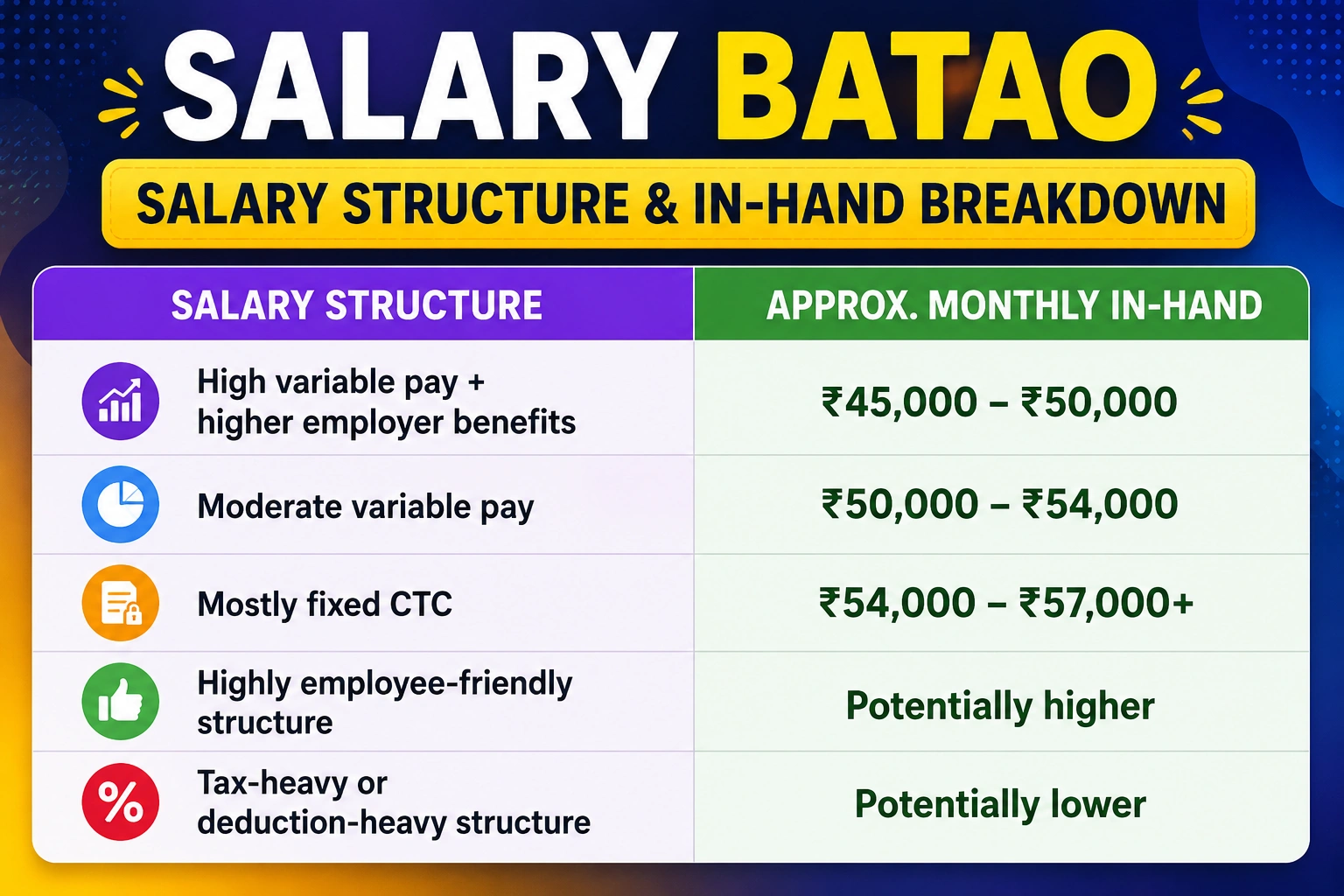
| Salary Structure | Approx. Monthly In-Hand |
|---|---|
| High variable pay + higher employer benefits | ₹45,000–₹50,000 |
| Moderate variable pay | ₹50,000–₹54,000 |
| Mostly fixed CTC | ₹54,000–₹57,000+ |
| Highly employee-friendly structure | Potentially higher |
| Tax-heavy or deduction-heavy structure | Potentially lower |
These are illustrative ranges, not payroll guarantees.
If someone tells you that every ₹7.5 LPA job gives exactly ₹55,000 in hand, they’re oversimplifying the calculation.
7.5 LPA 30% Hike: What Does It Mean?
If you currently earn ₹7.5 LPA and receive a 30% hike, your new CTC would be:
₹7,50,000 × 1.30 = ₹9,75,000
So:
- Current CTC: ₹7.5 LPA
- 30% hike: ₹2.25 lakh
- New CTC: ₹9.75 LPA
But here’s the mistake many employees make:
They assume a 30% hike means their in-hand salary will rise by exactly 30%.
It may not.
Why?
Because the new package may have:
- Higher variable pay
- Different PF structure
- Higher taxable income
- Joining bonus
- Retention bonus
- Employer benefits
- Different salary components
My career advice
When negotiating a hike, compare:
Current fixed pay → New fixed pay
not merely:
Current CTC → New CTC
A ₹9.75 LPA package with ₹1.5 lakh variable compensation may be less attractive than a ₹9.25 LPA package that is almost entirely fixed.
Cash certainty beats inflated CTC.
7.5 LPA Salary vs Other Common Salary Packages
| Annual CTC | Monthly CTC Equivalent | Typical In-Hand Range* |
|---|---|---|
| ₹5 LPA | ₹41,667 | ₹34,000–₹38,000 |
| ₹6 LPA | ₹50,000 | ₹40,000–₹44,000 |
| ₹7.5 LPA | ₹62,500 | ₹48,000–₹57,000 |
| ₹8 LPA | ₹66,667 | ₹52,000–₹60,000 |
| ₹10 LPA | ₹83,333 | ₹63,000–₹72,000 |
*Illustrative estimates. Actual take-home depends on the CTC structure, variable pay, PF, tax regime and deductions.
Notice something important: CTC increases don’t translate linearly into take-home salary.
That is why comparing offers purely by LPA is a weak way to evaluate compensation.
7.5 LPA in USD: How Much Is It?
At ₹7.5 lakh per year:
₹7,50,000 ÷ 12 = ₹62,500 per month
To convert 7.5 LPA in USD, you need the current INR/USD exchange rate.
Because exchange rates fluctuate daily, the USD equivalent changes over time.
The correct formula is:
₹7,50,000 ÷ current INR per USD exchange rate
For example, if the exchange rate were ₹85 per US$1:
₹7,50,000 ÷ 85 ≈ US$8,824 per year
That is a currency conversion of CTC—not your Indian take-home salary.
Capgemini 7.5 LPA In-Hand Salary and TCS 7.5 LPA In-Hand Salary
Searches such as “Capgemini 7.5 LPA in hand salary” and “TCS 7.5 LPA in hand salary” often assume that the company name alone determines take-home pay.
It doesn’t.
Your actual salary depends on:
- Your employment grade
- Fixed vs variable pay
- Basic salary
- PF policy
- Gratuity inclusion
- Insurance
- Location-specific deductions
- Tax treatment
- Joining or retention bonuses
Therefore, a 7.5 LPA offer from Capgemini and a 7.5 LPA offer from TCS could have different monthly take-home amounts.
What you should compare
Ask the recruiter for:
- Fixed annual compensation
- Variable annual compensation
- Basic salary
- Employer PF
- Gratuity
- Insurance premium included in CTC
- Joining bonus
- Retention bonus
- Expected monthly gross
- Estimated monthly net salary
Then compare the offers.
Don’t compare brand names and headline CTC alone.
Mini Case Study: Two Employees, Same 7.5 LPA
Let’s look at two hypothetical employees.
Employee A: Fixed-heavy package
- CTC: ₹7.5 LPA
- Low variable pay
- Moderate employer benefits
- Standard PF
- Monthly take-home: approximately ₹54,000
Employee B: Variable-heavy package
- CTC: ₹7.5 LPA
- ₹70,000–₹1,00,000 variable component
- Higher employer-side benefits
- Standard PF
- Monthly take-home: approximately ₹48,000–₹51,000
Both employees tell their friends:
“I earn 7.5 LPA.”
But their monthly financial reality is different.
Employee A has greater monthly cash flow.
Employee B may have a similar annual total compensation only if the variable pay is fully earned.
The strategic lesson
When evaluating a job offer, use this priority:
Fixed cash > guaranteed benefits > variable pay > headline CTC
That’s not an absolute rule, but it’s a much better starting point than blindly chasing the highest LPA number.
Is 7.5 LPA a Good Salary in India in 2026?
The answer depends on three variables:
- Your experience
- Your location
- Your skill set
For a fresher, ₹7.5 LPA can be a strong starting package in many fields.
For someone with five years of experience in a high-demand technical role, ₹7.5 LPA may be below market expectations.
For someone living in a lower-cost city, ₹7.5 LPA may provide significantly more disposable income than the same salary in Mumbai, Bengaluru or Delhi NCR.
The broader salary environment also matters. Aon projected average salary increases in India of 9.1% for 2026, based on research covering more than 1,400 organisations across 45 industries. Aon also projected 6.8% growth for technology consulting and services, while NBFCs were projected at 10.0% and real estate/infrastructure at 10.9%.
Deloitte’s 2026 India Talent Outlook similarly projected average increments of 9.1%, while noting a more cautious environment in technology and services. Its survey also reported a 14% promotion rate and said nearly three-quarters of organisations have both behavioural and technical competency frameworks.
My interpretation
The market is increasingly rewarding skills that directly affect business outcomes, not simply years of experience.
If you’re earning ₹7.5 LPA today, your goal shouldn’t be:
“How do I get a 10% annual hike?”
A better question is:
“What skill or responsibility can move my market value from ₹7.5 LPA to ₹10–12 LPA?”
That shift in thinking is more powerful than obsessing over monthly deductions.
How to Increase Your Salary From 7.5 LPA
If your current salary is ₹7.5 LPA, use this four-step approach.
Step 1: Calculate Your Real Compensation
Break your CTC into:
- Fixed salary
- Variable salary
- Employer PF
- Gratuity
- Insurance
- Bonuses
Find your actual fixed compensation.
Step 2: Identify Your Market Gap
Compare your current compensation with:
- Job postings
- Recruiter conversations
- Industry salary reports
- Peer benchmarks
- Interviews
Don’t rely on one salary website.
Step 3: Build a High-Value Skill
Examples include:
- Cloud computing
- Data engineering
- Cybersecurity
- AI/ML
- Product management
- Enterprise sales
- Financial analysis
- Automation
- Advanced analytics
The exact skill matters less than whether companies are actively paying more for it.
Step 4: Create Evidence
Don’t say:
“I know Python.”
Say:
“I automated a reporting process that reduced manual work by 40%.”
Don’t say:
“I’m good at marketing.”
Say:
“I increased organic traffic by 80% and generated 35% more qualified leads.”
The market pays more for demonstrated outcomes than certificates alone.
Common Mistakes When Calculating 7.5 LPA In-Hand Salary
Mistake 1: Dividing CTC by 12
₹7.5 lakh ÷ 12 = ₹62,500.
That’s monthly CTC equivalent—not necessarily take-home.
Mistake 2: Ignoring Variable Pay
A ₹7.5 LPA package with ₹1 lakh variable pay is not equivalent to ₹7.5 LPA of guaranteed fixed salary.
Mistake 3: Ignoring Employer PF and Gratuity
These may appear in CTC but do not necessarily arrive in your monthly bank account.
Mistake 4: Assuming Tax Is the Biggest Deduction
At this income level, depending on your taxable income and tax regime, income tax may be relatively limited or potentially nil under the applicable new-regime rebate rules. PF and other payroll deductions can therefore have a more visible effect on monthly take-home pay.
Mistake 5: Comparing Only CTC
Two ₹7.5 LPA offers can have radically different:
- Fixed pay
- Variable pay
- Take-home salary
- Benefits
- Career growth
Always compare the salary structure, not just the headline number.
Latest and Commonly Searched LPA Salaries in 2026
Curious how 7.5 LPA stacks up against other common salary brackets? Here’s a quick side-by-side so you can see where it fits on the bigger ladder.
| Annual Salary (LPA – Lakh per Annum) | Monthly Salary Range (INR) | Yearly Salary Range (INR) |
|---|---|---|
| 1 LPA in hand salary | ₹7,600 – 8,300 | ₹91,600 – 1,00,000 |
| 1.5 LPA in hand salary | ₹11,500 – 12,500 | ₹1,38,600 – 1,50,000 |
| 2 LPA in hand salary | ₹15,500 – 16,600 | ₹1,85,600 – 1,97,600 |
| 2.3 LPA in hand salary | ₹17,817 – 19,100 | ₹2,13,000 – 2,27,600 |
| 3 LPA in hand salary | ₹23,300 – 25,000 | ₹2,79,600 – 2,97,600 |
| 3.8 LPA in hand salary | ₹29,500 – 31,400 | ₹3,54,800 – 3,77,600 |
| 3.9 LPA in hand salary | ₹30,350 – 32,300 | ₹3,64,200 – 3,87,600 |
| 4 LPA in hand salary | ₹31,100 – 33,133 | ₹3,73,600 – 3,97,600 |
| 4.5 LPA in hand salary | ₹30,000 – 32,000 | ₹3,60,000 – 3,80,000 |
| 5 LPA in hand salary | ₹38,900 – 41,400 | ₹4,67,600 – 4,97,600 |
| 5.5 LPA in hand salary | ₹42,800 – 45,600 | ₹5,14,600 – 5,47,600 |
| 6 LPA in hand salary | ₹45,500 – 49,800 | ₹5,61,600 – 5,97,600 |
| 7 LPA in hand salary | ₹51,000 – 54,600 | ₹6,12,000 – 6,55,200 |
| 8 LPA in hand salary | ₹57,200 – 62,400 | ₹6,87,400 – 7,49,600 |
| 8.5 LPA in hand salary | ₹60,400 – 66,384 | ₹7,24,800 – 7,96,600 |
| 9 LPA in hand salary | ₹63,600 – 70,300 | ₹7,63,200 – 8,43,600 |
| 9.2 LPA in hand salary | ₹64,900 – 71,800 | ₹7,74,800 – 8,62,400 |
| 9.5 LPA in hand salary | ₹66,800 – 73,700 | ₹8,00,000 – 8,84,900 |
| 9.6 LPA in hand salary | ₹67,400 – 74,400 | ₹8,08,000 – 8,93,000 |
| 9.8 LPA in hand salary | ₹68,700 – 75,700 | ₹8,24,400 – 9,09,000 |
| 10 LPA in hand salary | ₹70,000 – 77,000 | ₹8,40,000 – 9,25,000 |
| 11 LPA in hand salary | ₹76,300 – 76,300 | ₹9,15,600 – 10,05,000 |
| 11.5 LPA in hand salary | ₹79,300 – 87,100 | ₹9,51,600 – 10,45,300 |
| 12 LPA in hand salary | ₹82,000 – 90,400 | ₹9,84,000 – 10,85,400 |
| 13 LPA in hand salary | ₹87,600 – 97,100 | ₹10,51,200 – 11,65,800 |
| 13.5 LPA in hand salary | ₹90,300 – 1,00,400 | ₹10,83,600 – 12,05,700 |
| 14 LPA in hand salary | ₹93,100 – 1,03,800 | ₹11,17,200 – 12,45,800 |
| 15 LPA in hand salary | ₹98,600 – 1,10,500 | ₹11,83,200 – 13,26,000 |
| 16 LPA in hand salary | ₹1,04,100 – 1,17,100 | ₹12,49,200 – 14,06,200 |
| 16.5 LPA in hand salary | ₹1,06,900 – 1,20,500 | ₹12,82,800 – 14,46,800 |
| 17 LPA in hand salary | ₹1,09,700 – 1,23,700 | ₹13,16,400 – 14,84,400 |
| 17.5 LPA in hand salary | ₹1,12,400 – 1,26,700 | ₹13,48,800 – 15,21,000 |
| 18 LPA in hand salary | ₹1,15,200 – 1,29,800 | ₹13,82,400 – 15,57,700 |
| 19 LPA in hand salary | ₹1,20,700 – 1,35,900 | ₹14,48,400 – 16,31,000 |
| 20 LPA in hand salary | ₹1,26,200 – 1,42,000 | ₹15,14,400 – 17,04,300 |
As with all figures in this article, these are estimated ranges — actual take-home pay depends on your employer’s specific CTC structure, applicable state taxes, and current tax slab rules.
Your 7.5 LPA Salary Offer Checklist
Before accepting a ₹7.5 LPA job, ask HR:
What is my fixed annual compensation?
What is my variable compensation?
Is variable pay guaranteed?
What is my monthly gross salary?
What is my basic salary?
How much employee PF will be deducted?
Is employer PF included in CTC?
Is gratuity included in CTC?
Is insurance included in CTC?
Are bonuses included in the ₹7.5 LPA?
What is my expected monthly take-home?
Which tax regime is assumed for TDS?
Is there a joining or retention bonus?
Are there any salary deductions I should know about?
If HR cannot give you a clear answer, don’t pretend the package is clear.
Key Takeaways
- 7.5 LPA = ₹7,50,000 annual CTC in the common usage of salary packages.
- 7.5 LPA monthly CTC equivalent = ₹62,500.
- Your actual 7.5 LPA in hand salary is usually lower than ₹62,500.
- A practical estimated take-home range is around ₹48,000–₹57,000 per month, depending heavily on the salary breakup.
- Employer PF, gratuity, insurance and variable pay can significantly reduce the cash portion of CTC.
- Under the 2026 new tax regime, eligible resident individuals within the applicable rebate threshold may have no income tax liability, but your exact tax position depends on taxable income and personal circumstances.
- EPF deductions depend on the applicable PF wage/base structure; EPFO states the standard employee contribution is 12% of basic wages plus applicable components.
- A 7.5 LPA offer with high fixed pay can be financially better than a higher CTC with a large variable component.
- For career growth, focus on marketable skills and measurable business outcomes, not only annual appraisal percentages.
Short Summary
7.5 LPA means ₹7.5 lakh per year or ₹62,500 per month in CTC terms. However, your actual 7.5 LPA in hand salary is likely to be lower because CTC can include employer PF, gratuity, insurance and variable compensation. In 2026, a realistic take-home estimate for many standard salary structures is approximately ₹48,000–₹57,000 per month, although your exact amount depends on your offer letter and payroll deductions. Under the current new tax regime, eligible taxpayers at this income level may have no income tax liability because of the applicable rebate rules, making PF and salary structure particularly important when estimating take-home pay.
FAQs About 7.5 LPA In Hand Salary
1. What is 7.5 LPA in hand salary per month?
The 7.5 LPA in hand salary per month is commonly around ₹48,000–₹57,000, depending on fixed pay, variable compensation, PF, gratuity, insurance and other deductions. The exact amount can only be calculated from your salary breakup.
2. What is 7.5 LPA means monthly salary?
7.5 LPA means ₹7,50,000 per year, which equals ₹62,500 per month as a CTC equivalent. Your actual bank credit will generally be lower.
3. What is the in hand salary for 7.5 LPA?
The in hand salary for 7.5 LPA can typically fall around ₹48,000–₹57,000 per month. A fixed-heavy package may give you more monthly take-home, while a package with substantial variable pay may give you less.
4. How much tax for 7.5 LPA?
For eligible resident individuals under the 2026 new tax regime, tax may be zero if taxable income falls within the applicable Section 87A rebate threshold. However, the exact calculation depends on taxable income and your individual circumstances.
5. For 7.5 LPA which tax regime is better?
For many salaried employees earning around 7.5 LPA, the new tax regime may be more beneficial, particularly when they have few deductions or exemptions. However, employees with substantial eligible deductions should compare both regimes before making a final decision.
