
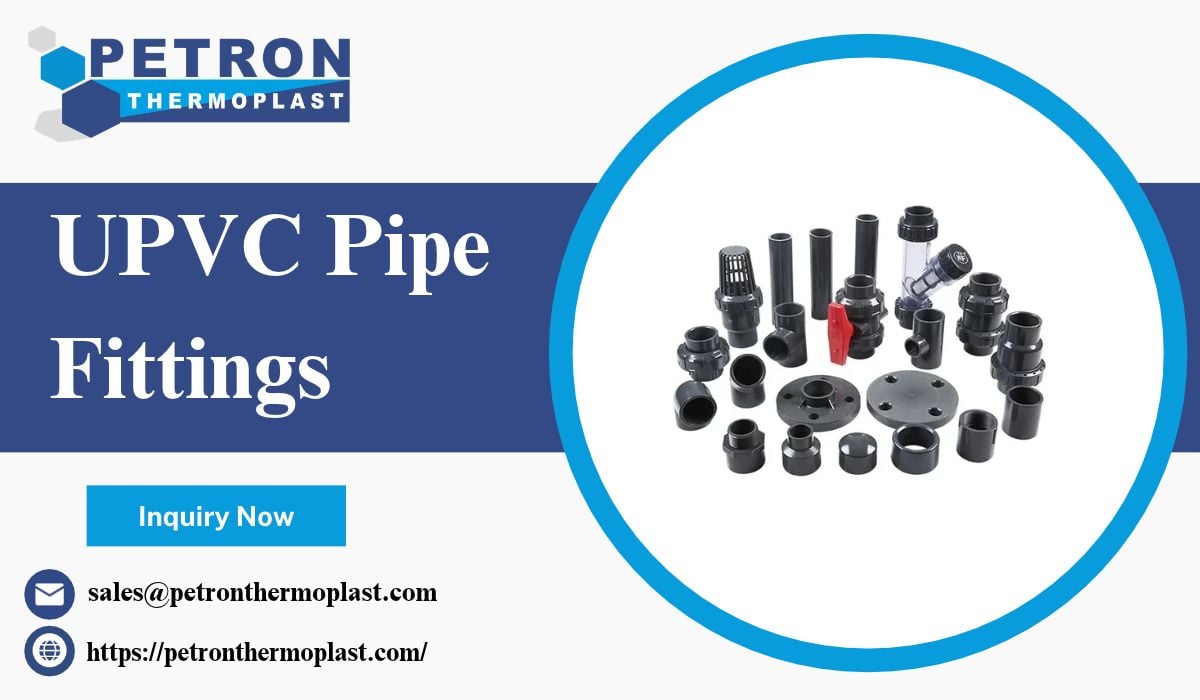
Industrial pipeline systems require reliable components to ensure efficient fluid transportation, secure connections, and long-term operational performance. UPVC Pipe Fittings play an important role in modern industrial infrastructure because of their lightweight construction, corrosion resistance, and suitability for various water and chemical handling applications. From chemical processing plants to water treatment facilities, these fittings help create flexible and efficient piping networks.
For global industrial projects, standard piping components may not always meet specific engineering requirements. Customized UPVC pipe fittings provide flexibility in dimensions, connection types, pressure ratings, and configurations. Petron Thermoplast focuses on manufacturing UPVC pipe fittings for industrial applications, offering solutions for customized pipeline engineering, bulk requirements, and international projects.
What Are Customized UPVC Pipe Fittings?
Customized UPVC pipe fittings are specially manufactured or configured pipeline components designed according to specific project requirements. UPVC stands for Unplasticized Polyvinyl Chloride, a thermoplastic material widely used in industrial and commercial piping systems.
These fittings connect different pipeline sections, change flow directions, control pipe dimensions, and create branch connections. They are available in different shapes, sizes, and configurations to accommodate various installation requirements.
Customized fittings are particularly useful in projects where standard dimensions or conventional connection arrangements are unsuitable. Depending on the application, fittings can be selected according to pipe diameter, wall thickness, pressure class, connection type, and operating conditions.
Why Are UPVC Pipe Fittings Important for Global Industrial Projects?
International industrial projects require piping components that meet specific engineering, operational, and installation requirements. UPVC pipe fittings are considered for applications where chemical compatibility, corrosion resistance, and efficient installation are important.
Some important advantages include:
- Corrosion Resistance: UPVC provides resistance to many acids, alkalis, salts, and compatible industrial chemicals.
- Lightweight Construction: Easier transportation, handling, and installation compared with many metallic alternatives.
- Low Maintenance: Non-metallic construction eliminates rust-related maintenance.
- Reliable Connections: Compatible fittings help create secure pipeline connections.
- Design Flexibility: Available in different sizes, shapes, and configurations.
- Smooth Internal Surface: Helps support efficient fluid transportation and reduces friction losses.
- Long-Term Performance: Suitable material selection and proper installation support reliable service life.
Types of Customized UPVC Pipe Fittings
Different industrial pipeline networks require different fitting configurations. Some commonly used UPVC pipe fittings include:
1. UPVC Elbow
UPVC Elbows are used to change the direction of fluid flow within a pipeline. Common configurations include 45-degree and 90-degree elbows. They are suitable for industrial piping layouts where directional changes are required.
2. UPVC Tee
UPVC Tee fittings create branch connections from the main pipeline. They are available in equal and reducing configurations according to pipeline dimensions.
3. UPVC Reducer
UPVC Reducers connect pipelines of different diameters. They help accommodate changes in pipeline size while maintaining a suitable flow arrangement.
4. UPVC Coupling
UPVC Couplings connect two compatible pipe sections. They are commonly used in pipeline extensions, repairs, and installation work.
5. UPVC Flange
UPVC Flanges provide detachable connections between pipes, valves, pumps, and other industrial equipment. They simplify inspection, maintenance, and equipment replacement.
6. UPVC Cross
UPVC Cross fittings provide four-way pipeline connections. They are used in selected industrial distribution and processing networks.
7. UPVC End Cap
UPVC End Caps close open pipeline ends and help prevent unwanted fluid discharge.
8. UPVC Union
UPVC Union fittings allow pipeline sections to be disconnected without cutting the pipe. They are useful in installations requiring periodic maintenance.
Technical Specifications of UPVC Pipe Fittings
Technical specifications are essential when selecting fittings for industrial pipeline installations. The following table provides general product information.
|
Technical Parameter |
Specification |
| Product Name | UPVC Pipe Fittings |
| Material | Unplasticized PVC |
| Available Types | Elbow, Tee, Reducer, Coupling, Flange, Union |
| Size Range | As per manufacturing specifications |
| Connection Type | Socket / Threaded / Flanged |
| Pressure Rating | As per product design and applicable standard |
| Colour | As manufactured |
| Operating Temperature | According to material and pressure limitations |
| Chemical Resistance | Suitable for compatible chemicals |
| Manufacturing | Moulded / Fabricated / Machined, as applicable |
| Application | Industrial Fluid Transportation |
| Customization | Available according to project requirements |
Industries Using Customized UPVC Pipe Fittings
UPVC pipe fittings are used across several industries where reliable fluid transportation and corrosion resistance are important.
Chemical Processing Plants
Chemical industries use UPVC fittings in compatible chemical transfer lines, process piping networks, and fluid distribution systems.
Water Treatment Plants
These fittings are used in water treatment pipelines, filtration arrangements, and water distribution networks.
Pharmaceutical Industries
UPVC piping components are considered for suitable utility and chemical handling applications where material compatibility is established.
Electroplating Industries
Electroplating facilities use compatible UPVC fittings in chemical circulation lines and selected process piping arrangements.
Textile Industries
UPVC fittings support the transportation of compatible industrial liquids and chemical solutions used in textile processing.
Fertilizer Manufacturing
These fittings can be used in selected chemical transfer and water handling systems within fertilizer production facilities.
Wastewater Treatment Plants
UPVC components are suitable for compatible wastewater collection, treatment, and distribution applications.
Benefits of Customized UPVC Pipe Fittings
Customized manufacturing helps industrial buyers select piping components according to their actual installation and engineering requirements.
1. Project-Specific Dimensions
Fittings can be selected or manufactured according to required pipe diameters, dimensions, and connection arrangements.
2. Flexible Pipeline Design
Customized configurations help accommodate complex industrial piping layouts and limited installation spaces.
3. Suitable Material Selection
UPVC material offers corrosion resistance for many compatible chemical and water handling applications.
4. Installation Convenience
Properly selected connection arrangements help simplify pipeline installation and maintenance.
5. Bulk Project Requirements
Customized manufacturing can support large-scale industrial projects requiring multiple fitting sizes and configurations.
6. Reduced Maintenance Requirements
UPVC does not rust, helping reduce maintenance associated with metallic corrosion.
How to Select the Right UPVC Pipe Fittings?
Selecting appropriate UPVC pipe fittings is important for pipeline efficiency and operational reliability. Industrial buyers should evaluate the following factors before purchasing.
- Pipe Diameter: Select fittings that match the nominal diameter and dimensional requirements of the pipeline.
- Pressure Rating: Check the pressure class and maximum allowable working pressure.
- Chemical Compatibility: Confirm material suitability for the fluid, chemical concentration, and temperature.
- Connection Type: Choose socket, threaded, or flanged connections according to installation requirements.
- Operating Temperature: Verify the permitted temperature range and pressure derating requirements.
- Manufacturing Standard: Check applicable dimensional and product standards.
- Installation Conditions: Consider pipeline layout, support requirements, and maintenance accessibility.
- Project Quantity: Plan bulk requirements and customized specifications before placing an order.
Customized UPVC Pipe Fittings for International Export Projects
Global industrial projects often involve different engineering specifications, pipeline standards, and installation requirements. Export-oriented manufacturing requires proper coordination of product dimensions, material specifications, packaging, and documentation.
Customized UPVC pipe fittings can support international requirements through:
- Different fitting sizes and configurations.
- Project-specific technical specifications.
- Compatible connection arrangements.
- Bulk manufacturing capabilities.
- Export-oriented packaging requirements.
- Product documentation according to applicable requirements.
- Coordination for large industrial orders.
Why Choose Petron Thermoplast for Customized UPVC Pipe Fittings?
Petron Thermoplast focuses on manufacturing thermoplastic pipe fittings and industrial piping solutions for domestic and international customers. We understand that industrial projects require suitable product specifications, consistent quality, and customized manufacturing options.
Reasons to consider Petron Thermoplast include:
- Manufacturer Expertise: Focus on industrial thermoplastic products and piping components.
- Customized Solutions: UPVC fitting options according to project-specific dimensions and requirements.
- Product Variety: Different fitting configurations for industrial pipeline networks.
- Material Quality: Selection of suitable UPVC material for compatible applications.
- Bulk Order Support: Assistance with large-scale industrial and commercial requirements.
- Competitive Manufacturer Pricing: Direct manufacturer pricing for project-based purchases.
- Worldwide Export Support: Support for domestic and international industrial orders.
- Technical Assistance: Guidance regarding fitting specifications, dimensions, and application requirements.
Installation and Maintenance Tips
Proper installation helps maintain the performance and reliability of UPVC piping systems.
- Check fitting dimensions and material compatibility before installation.
- Use suitable solvent cement or connection methods as specified by the manufacturer.
- Ensure pipe ends are properly prepared before joining.
- Avoid excessive mechanical stress during installation.
- Provide suitable pipe supports to prevent unnecessary loading.
- Follow recommended curing times for solvent-welded connections.
- Inspect joints periodically for leakage or visible damage.
- Avoid operating the piping system beyond its specified pressure and temperature limits.
Conclusion
Customized UPVC pipe fittings are an important component of modern industrial pipeline systems. Their lightweight construction, corrosion resistance, flexible configurations, and low maintenance requirements make them suitable for many chemical handling, water treatment, and industrial fluid transportation applications.
For global industrial projects, selecting fittings according to pipe dimensions, pressure ratings, chemical compatibility, and installation requirements is essential. Customized manufacturing provides greater flexibility for complex pipeline networks and bulk industrial orders.
Petron Thermoplast focuses on manufacturing UPVC pipe fittings for customized industrial applications and international project requirements. Contact Petron Thermoplast to discuss your product specifications, bulk requirements, and customized pipeline engineering needs.
Frequently Asked Questions (FAQs)
1. What are UPVC pipe fittings used for?
UPVC pipe fittings are used to connect pipelines, change flow directions, create branch connections, reduce pipe diameters, and close pipeline ends.
2. Which types of UPVC pipe fittings are available?
Common types include elbows, tees, reducers, couplings, flanges, unions, crosses, and end caps.
3. Can UPVC pipe fittings be customized?
Yes. Suitable fitting dimensions, configurations, and connection arrangements can be customized according to project specifications and manufacturing capabilities.
4. Are UPVC pipe fittings suitable for chemical industries?
Yes. UPVC fittings can be used for many compatible chemical applications. Chemical concentration and operating temperature should be checked before selection.
5. What are the advantages of UPVC pipe fittings over metal fittings?
UPVC fittings are lightweight, corrosion-resistant, and do not rust. They can also reduce maintenance associated with metallic corrosion in suitable applications.
6. Are UPVC pipe fittings suitable for international projects?
Yes. They can be used in international industrial projects when their dimensions, pressure ratings, material specifications, and applicable standards meet project requirements.
7. Does Petron Thermoplast manufacture UPVC pipe fittings for bulk orders?
Petron Thermoplast offers UPVC pipe fitting solutions for industrial and bulk project requirements, including customized specifications and international export needs.
